Naturli Spreadable vs Flora Buttery

For the past few years Naturli has been our preferred vegan alternative to butter. It has a buttery flavour, comes in both spreadable and block forms, and is also organic. However, during a recent stay in London we tried Flora Buttery, and it tastes even better. I’m vegan for ethical reasons though, so taste isn’t the only consideration, and I’ve decided to stick with Naturli for its lower environmental impact. Read on for a detailed comparison.

A tub of Flora, in a golden colour with a picture of a sunflower, and a tub of Naturli, in black with a picture of it spread on bread

Price

For a 450g tub, Sainsbury’s currently charges £3.90 for Naturli and £2.50 for Flora.

Appearance

Both spreads have a similar consistency and colour. Naturli is coloured with carrot juice and Flora is coloured with beta carotene (possibly also from carrots).

Ingredients

Naturli is made from a blend of 39% rapeseed oil, 22% coconut oil, 13% shea butter, and 2% almond, along with smaller quantities of salt, carrot juice, lecithin, and lemon juice. Flora is made from a blend of rapeseed oil, sunflower oil, and linseed oil in varying proportions, along with smaller quantities of coconut fat, lecithin, fava beans, salt, and beta carotene. Both spreads are free from palm oil.

Nutrition (per 100g)

Both spreads have 75g of fat, with Naturli having 25g of saturated fat and Flora having 28g. Both spreads have less than 0.5g of carbohydrate and protein. Naturli has 0.9g of salt while Flora has 1.3g, which may account for me preferring the taste of Flora.

Environmental impact

Naturli has a carbon footprint of 2.93kg CO2e per kilogram according to CarbonCloud, while Flora has a carbon footprint of 4.5kg CO2e per kilogram according to Quantis. In addition to its lower carbon footprint, Naturli is also organic.

Review: Cooking for programmers 0x00

For software developers, Christmas means two things: dealing with bugs that waited until Christmas Day to make themselves known, and receiving gimmicky gifts. This year I was given Cooking for programmers 0x00, a cookbook whose recipes are written in the form of code from seventeen different programming languages. In keeping with the hacker tradition of taking jokes way too seriously, here’s my review.

The recipes

The recipes are for simple dishes such as carrot cake, tomato soup, and crêpes. I decided to try the PHP rice pudding, which involves simmering risotto rice in sweetened milk — I used oat milk — for half an hour. The resulting pudding, served with a dollop of raspberry jam, was a little disappointing. In the UK we tend to make rice pudding with a special high-starch rice variety known as ‘pudding rice’, which gives a creamy consistency, whereas this recipe’s use of risotto rice kept the grains more distinct.

The code

The blurb on the back of the book claims it gives you “the opportunity to get a feeling for programming languages you have not yet used”. Based the on the recipes in languages I have used, this book doesn’t give an good impression of typical code in these languages. The PHP code uses the global keyword and has untyped function signatures, the Typescript code has a huge switch statement turning strings into identical strings when an enum should have been used instead, and the Rust code using string concatenation when the format! macro would have been more readable.

In summary, this book is neither a useful cookbook nor a good overview of how different programming languages approach a similar problem. After forty-five years, the Unix philosophy still applies: do one thing and do it well. And remember: hackers always take jokes too seriously.

Christmas 2023: Battle of The Pigs In Blankets

At some point over the last few days I realised that my habit of buying any vegan pigs in blankets I see in the wild has lead to a problem. Namely that I have way too many pigs in blankets to eat on Christmas Day. So why not have a festive Christmas Eve buffet of nothing but pigs in blankets and also draw up a score board to justify this gluttony.

The rules of this contest are as follows. We had three brands of pigs: Plant Kitchen from M&S, Plant Menu from Aldi, and This Isn’t that we got from Tesco. Kate and I had two each to sample and then we had to come up with a score out of five, which would be added together to make a score out of ten. Though actually that ended up being pointless, we gave everything the exact same score as each other. We’ve probably been together too long.

The This Isn’t Pork offering looked pleasingly rustic and cooked in the shortest time. We both thought it had the best bacon but the whole thing was let down by the sausage. The sausage is herby and overpowering. It’s not what you want from the piggie in your blanket. We gave this a 4 out of 10.

Plant Kitchen is next. These took the longest to cook, and were messy to get out of the packet. The sausage is a more mushroom-based offering. It has a casing which makes it the more realistic of today’s sausage. It overpowered the bacon though and was a little too greasy. We like these ones and gave them a 6 out of 10.

Our favourites are these Plant Menu piggies. They’re more of a balanced taste and not as greasy. They do look weirdly artificial but you can’t argue with the taste. 8 out of 10.

Recipe: Marmalade and Chocolate Chip Cookies

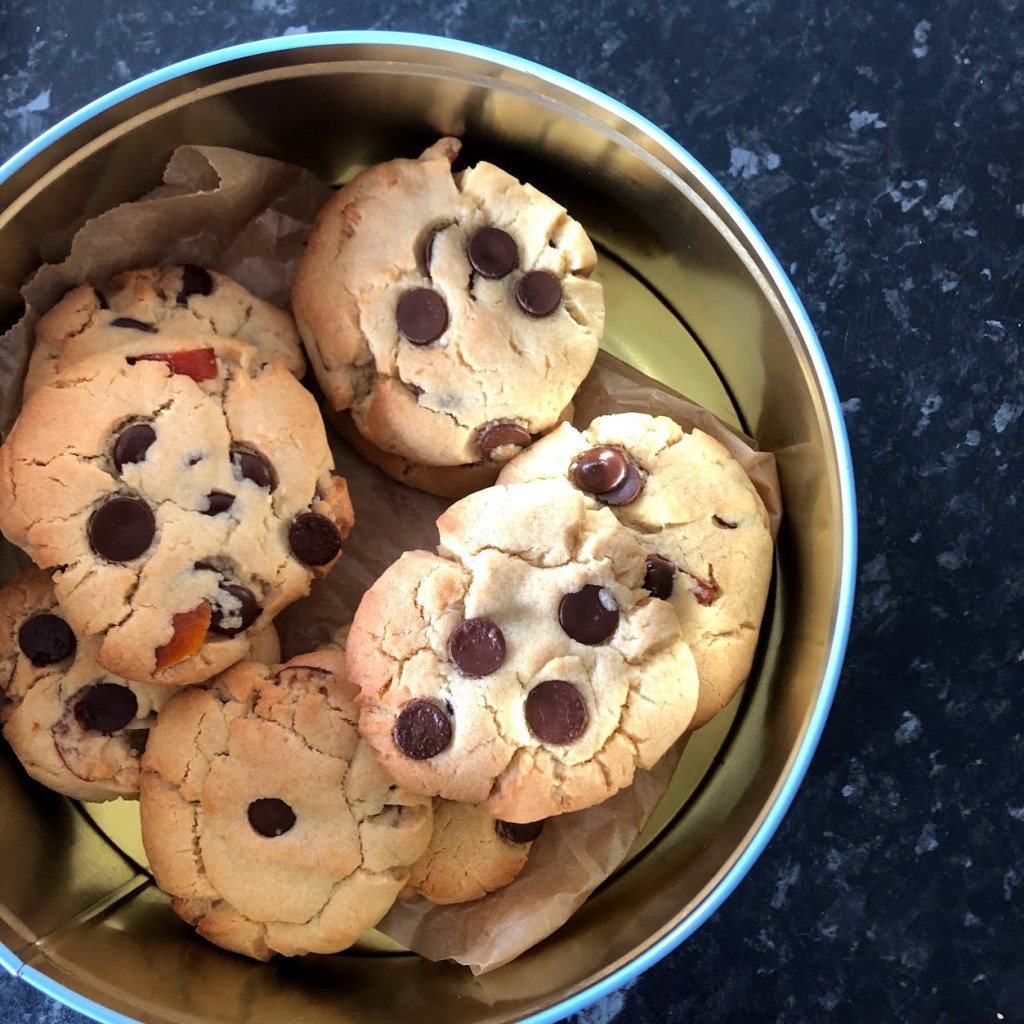
A tin full of cookies with chocolate chip and candied orange peel showing through

Because I haven’t seen my family in a while, I was feeling rather generous towards them. Because I was feeling rather generous towards them, I made marmalade. Because I made marmalade, I had leftover marmalade. Because I had leftover marmalade, I’ve revitalised this recipe from the old blog.

Home-made marmalade is best, with nice big chunks of candied orange peel.

Ingredients

110g vegan butter (we use Naturli)
65g caster sugar
95g marmalade
250g plain flour
1/2 teaspoon bicarbonate of soda
1/2 teaspoon salt
50g of chocolate chips

Pre-heat the oven to 180ºC and prepare a baking tray

Cream together the butter, sugar and marmalade.

Mix in the flour, bicarb, and salt, and form a dough.

With your hands, gently knead the chocolate chips into the dough.

Break off a tablespoon’s worth of dough and roll into a ball. It may be easier to wet your hands to do this. Flatten the ball slightly against the baking tray.

Repeat until you have about 12 cookies on the tray. Or until you run out of dough.

Cook in the oven for 10 minutes.

Allow to cool on the tray for five minutes before transferring to a wire rack to cool completely.

Finished cookies cooling on the baking tray