Naturli Spreadable vs Flora Buttery

For the past few years Naturli has been our preferred vegan alternative to butter. It has a buttery flavour, comes in both spreadable and block forms, and is also organic. However, during a recent stay in London we tried Flora Buttery, and it tastes even better. I’m vegan for ethical reasons though, so taste isn’t the only consideration, and I’ve decided to stick with Naturli for its lower environmental impact. Read on for a detailed comparison.

A tub of Flora, in a golden colour with a picture of a sunflower, and a tub of Naturli, in black with a picture of it spread on bread

Price

For a 450g tub, Sainsbury’s currently charges £3.90 for Naturli and £2.50 for Flora.

Appearance

Both spreads have a similar consistency and colour. Naturli is coloured with carrot juice and Flora is coloured with beta carotene (possibly also from carrots).

Ingredients

Naturli is made from a blend of 39% rapeseed oil, 22% coconut oil, 13% shea butter, and 2% almond, along with smaller quantities of salt, carrot juice, lecithin, and lemon juice. Flora is made from a blend of rapeseed oil, sunflower oil, and linseed oil in varying proportions, along with smaller quantities of coconut fat, lecithin, fava beans, salt, and beta carotene. Both spreads are free from palm oil.

Nutrition (per 100g)

Both spreads have 75g of fat, with Naturli having 25g of saturated fat and Flora having 28g. Both spreads have less than 0.5g of carbohydrate and protein. Naturli has 0.9g of salt while Flora has 1.3g, which may account for me preferring the taste of Flora.

Environmental impact

Naturli has a carbon footprint of 2.93kg CO2e per kilogram according to CarbonCloud, while Flora has a carbon footprint of 4.5kg CO2e per kilogram according to Quantis. In addition to its lower carbon footprint, Naturli is also organic.

Review: Cooking for programmers 0x00

For software developers, Christmas means two things: dealing with bugs that waited until Christmas Day to make themselves known, and receiving gimmicky gifts. This year I was given Cooking for programmers 0x00, a cookbook whose recipes are written in the form of code from seventeen different programming languages. In keeping with the hacker tradition of taking jokes way too seriously, here’s my review.

The recipes

The recipes are for simple dishes such as carrot cake, tomato soup, and crêpes. I decided to try the PHP rice pudding, which involves simmering risotto rice in sweetened milk — I used oat milk — for half an hour. The resulting pudding, served with a dollop of raspberry jam, was a little disappointing. In the UK we tend to make rice pudding with a special high-starch rice variety known as ‘pudding rice’, which gives a creamy consistency, whereas this recipe’s use of risotto rice kept the grains more distinct.

The code

The blurb on the back of the book claims it gives you “the opportunity to get a feeling for programming languages you have not yet used”. Based the on the recipes in languages I have used, this book doesn’t give an good impression of typical code in these languages. The PHP code uses the global keyword and has untyped function signatures, the Typescript code has a huge switch statement turning strings into identical strings when an enum should have been used instead, and the Rust code using string concatenation when the format! macro would have been more readable.

In summary, this book is neither a useful cookbook nor a good overview of how different programming languages approach a similar problem. After forty-five years, the Unix philosophy still applies: do one thing and do it well. And remember: hackers always take jokes too seriously.

Vegan honey from apple juice?

This post is part of VeganMoFo 2019, a month-long celebration of vegan food. This week’s theme is travel, and today’s prompt is a dish that transports you back to a vacation.

Many vegans feel guilt about their pre-vegan days, particularly when in comes to treasured memories that are decidedly non-vegan. My advice? Be kind to yourself: you were brought up in a society that normalises the consumption of animal products, and you didn’t know then what you know now.

Seven and a half years ago, Clare and I went on holiday to Center Parcs with Clare’s dad. After a morning swim and an afternoon of archery, Clare’s dad wanted to relax in the lodge, so Clare and I went swimming again on our own. Afterwards I suggested we try Ortega, the tapas restaurant in the Center Parcs village. I made three discoveries that night: that not drinking alcohol doesn’t mean we can’t enjoy cocktails (virgin piña colada for me and Spanish sunset for Clare); that sweet and savoury can work together (honey and cheese croquettes); and that having a meal with your girlfriend in a dimly-lit and otherwise empty restaurant, followed by a lakeside walk under lamplight, is incredibly romantic.

Seven and a half years later, we’re married and vegan. This evening Clare returned from a long weekend camping with the Guides, and I welcomed her home by restaging that meal. But what could I do about the honey and cheese croquettes? Fortunately Marks & Spencer have ‘not-zzarella sticks’ in their Plant Kitchen range, so I just had to make the honey.

honey

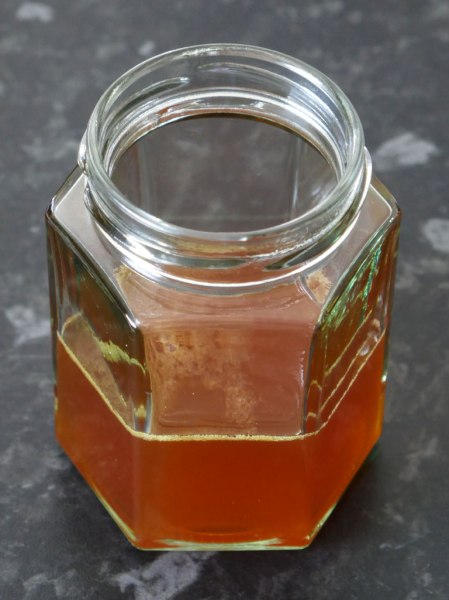
Search for vegan honey recipes and you’ll find dozens of variants on the same theme: combine two parts apple juice with one part sugar and boil down to half the original volume. I used golden syrup for the sugar. The result had a pleasing colour but still tasted strongly of apple juice. It worked well with the not-zzarella sticks, but no-one is going to be fooled into thinking it’s honey. The romantic meal, though? Just perfect.


French onion soup (recipe)

This post is part of VeganMoFo 2019, a month-long celebration of vegan food. This week’s theme is travel, and today’s prompt is favourite international dish.

I’m not usually keen on onion-centric food: onion rings have too strong a flavour for me, and I don’t like the crunch of lightly-cooked onions when they’re part of a larger dish. However, at my company’s annual conference last year the vegan option was French onion soup, and to my surprise I enjoyed it.

This is proper slow food: I put on the deluxe edition of London Grammar’s Truth Is A Beautiful Thing as I started, and I was still cooking when the album finished an hour and twenty minutes later. The long cooking time makes the onions soft and silky, and mellows their flavour.

soup

Ingredients (per person)

2 onions
2 cloves garlic
1 tablespoon olive oil
½ teaspoon brown sugar
200ml vegetable stock (or water)
1 teaspoon red wine vinegar
¼ lemon
¼ teaspoon salt
Several pinches of black pepper

Method

Finely slice the onions and garlic.

Heat the oil in a saucepan and add the onions, garlic, and a tablespoon of water.

Cook over a low heat, stirring every few minutes, until the onions start to brown. This may take up to an hour. If the onions start to stick to the pan, add a little water.

Once the onions have started to brown, stir in the sugar and add the stock (or water) and vinegar.

Bring to the boil and then simmer for fifteen minutes. Season with the juice from the lemon, salt, and pepper.

Serve with slices of crusty French bread.